
The Calming Power of Tea (For Real)
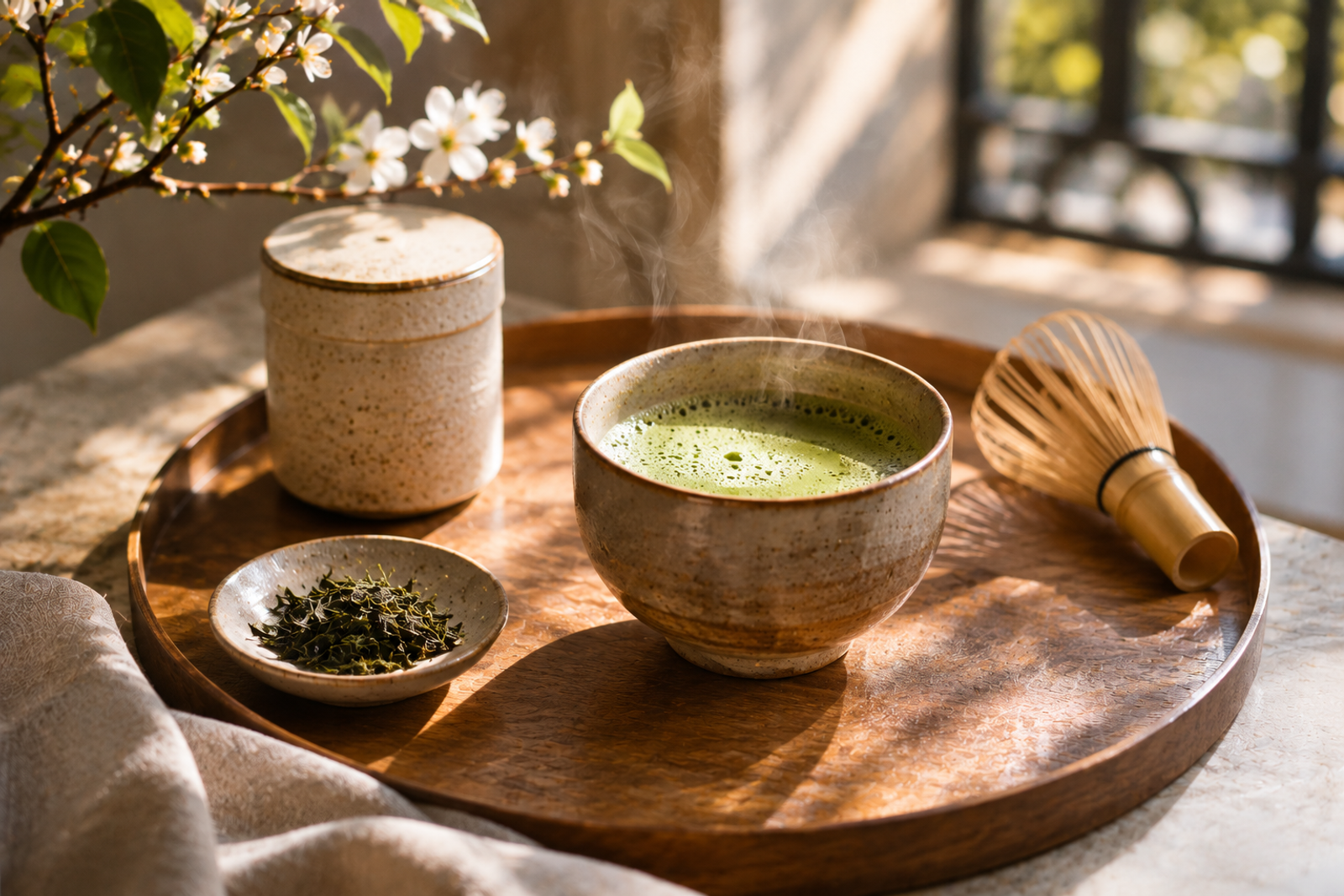
There is something quietly reassuring about making a cup of tea. The sound of water heating, the warmth of a cup between your hands, the brief interruption of a busy day. But does tea actually help us feel calmer, or is it the ritual itself that makes the difference? The answer lies somewhere between the chemistry of tea, the psychology of everyday habits, and our ability to give ourselves permission to pause.
On the science of slowing down, the pleasure of small rituals, and why a cup of tea is sometimes enough.
There is a particular kind of relief that comes with putting the kettle on.
Perhaps it's the sound of water beginning to boil. The warmth of a cup between your hands. Or the brief, unremarkable pleasure of watching tea leaves settle while the rest of the day carries on without you.
We tend to think of relaxation as something that requires effort: a meditation app, a weekend away, a carefully designed evening routine. Yet some of our most restorative moments happen in the ordinary spaces between obligations.
Tea belongs to those moments.
For centuries, it has accompanied conversation, contemplation, hospitality and solitude. Today, it also occupies a curious place in wellness culture, where everything from green tea to chamomile is promoted as a shortcut to calm.
But how much of that reputation is supported by science? And how much comes from the experience of making and drinking it?
The distinction is worth exploring.
First, what does tea actually do?
Traditional tea — green, black, white and oolong — comes from the same plant, Camellia sinensis. Its composition varies with cultivation, processing and preparation, but two naturally occurring compounds are particularly relevant to the conversation about relaxation: caffeine and L-theanine.
Caffeine stimulates the central nervous system. It can improve alertness, although the same effect may contribute to restlessness, particularly in people who are sensitive to it.
L-theanine, an amino acid found in tea leaves, has attracted scientific interest for its possible effects on stress, attention and mood.
In a systematic review published in Plant Foods for Human Nutrition, Williams and colleagues (2020) examined nine studies involving L-theanine supplementation. Their findings suggested that daily doses of 200–400 mg might help reduce stress responses under stressful conditions. However, the authors emphasised that larger, longer-term studies were needed before L-theanine could be established as a therapeutic intervention [1].
More recently, Payne and colleagues (2025) reviewed 50 randomised controlled trials investigating tea and its bioactive compounds. Their analysis identified some potentially beneficial effects on attention and mood, particularly for combinations of L-theanine and caffeine. Yet the findings were not uniformly conclusive, and the researchers called for more studies using actual tea beverages rather than isolated compounds [2].
There is an important detail often lost in wellness headlines: research on concentrated supplements does not necessarily tell us what happens when we drink an ordinary cup of tea.
Nor does it establish tea as a treatment for anxiety.
What the science offers is a more nuanced picture. Tea contains biologically active compounds that may influence how we feel and function, but the effects depend on dose, preparation and individual sensitivity.
And chemistry is only part of the story.
The quiet intelligence of a ritual
Consider the difference between drinking tea while answering emails and preparing a cup simply because you want one.
The ingredients may be identical. The experience is not.
Making tea involves a sequence of small, familiar actions. You fill the kettle, choose a cup, wait for the water and allow the leaves to steep.
There is a beginning, a middle and an end.
Unlike the endless stream of notifications and unfinished tasks that characterise much of contemporary life, this activity has a natural rhythm.
It also gives your attention somewhere uncomplicated to settle.
The warmth of the cup. The colour of the infusion. The first sip, perhaps taken a little too soon.
None of this proves that tea rituals have a specific clinical effect on stress. Research into tea compounds should not be confused with research into the psychological benefits of ritual itself.
Still, there is a practical distinction between taking a break and allowing yourself to experience one.
A cup consumed absent-mindedly at a desk is a drink. A cup enjoyed without interruption can become a small act of attention.
Sometimes, the value lies less in what tea does to the body than in what making tea allows us to stop doing.
A drink with many cultural lives
Tea is often presented in contemporary wellness imagery as a solitary experience: a beautiful cup, a quiet room, perhaps a book left open beside a window.
Its cultural history is considerably richer.
In Japan, chanoyu, the practice of preparing and serving matcha, brings together hospitality, aesthetics and carefully considered gestures. The attention given to objects, space and the encounter between host and guest makes tea part of a broader cultural experience.
In Morocco, mint tea is closely associated with hospitality and social life. The preparation and serving of tea can be as meaningful as the drink itself, creating a setting for conversation and welcome.
Korean tea traditions offer another perspective. Practices associated with darye, often translated as tea etiquette, place value on the relationship between preparation, conduct and the people sharing the occasion.
These traditions are distinct, shaped by different histories and social contexts. They should not be reduced to interchangeable versions of a modern wellness routine.
What they reveal is the remarkable range of meanings that people have attached to tea.
It can be contemplative or sociable, ceremonial or entirely informal.
A pause doesn't always have to mean being alone. Sometimes, sharing tea is the pause.
Which tea should you choose?
The answer depends less on which variety is supposedly the healthiest and more on what you want from the experience.
Green tea: for a moment of clarity
Green tea contains both caffeine and L-theanine, although the quantities vary considerably.
Its fresh, sometimes grassy character makes it appealing to people who enjoy a lighter-tasting infusion.
It can be a pleasant choice during the day, but anyone sensitive to caffeine should remember that green tea is not necessarily a sedative drink.
The US National Center for Complementary and Integrative Health (NCCIH) provides further information on green tea's composition, potential health effects and safety considerations [3].
Black tea: for familiarity and comfort
A strong breakfast tea with milk, a fragrant Earl Grey or a carefully brewed loose-leaf blend can offer a very different sensory experience.
Black tea often contains more caffeine than green tea, although the ranges overlap.
Its appeal may be less about relaxation in a physiological sense and more about familiarity: a taste associated with home, conversation or a welcome break.
Herbal infusions: for an evening without caffeine
Chamomile, rooibos, peppermint and lemon balm are commonly grouped with tea, although they are not made from the tea plant.
Many are naturally caffeine-free.
Chamomile is particularly associated with sleep and relaxation, but scientific evidence remains limited.
According to the NCCIH, preliminary research suggests that certain chamomile supplements may help with symptoms of generalised anxiety disorder. However, there is insufficient reliable evidence to establish chamomile as an effective treatment for insomnia [4].
That is not a reason to stop enjoying chamomile.
It is simply a reason to distinguish a pleasant evening habit from a proven medical intervention.
Herbal ingredients can also cause allergic reactions or interact with medicines, so natural does not automatically mean risk-free.
The art of doing a little less
Perhaps the most useful thing about a tea ritual is that it doesn't require you to become a different person.
You don't need a collection of handmade ceramics, an elaborate tea ceremony or a morning routine that begins at five.
You need a cup you like, something you enjoy drinking and a few minutes in which you aren't trying to achieve anything.
That might mean making tea after lunch and sitting by the window instead of returning immediately to your screen.
It might mean choosing a caffeine-free infusion in the evening, particularly if you find that caffeinated drinks interfere with your sleep.
Or it might mean inviting someone to stay for another cup, allowing a conversation to continue without checking the time.
The details are personal. They should be.
A ritual becomes meaningful through repetition and association, not because it looks impressive from the outside.
And if you occasionally drink your tea standing in the kitchen, distracted and in a hurry? Nothing has gone wrong.
Pleasure does not need another set of rules.
So, can a cup of tea really make you feel better?
It might help you feel more comfortable, more attentive or simply more at ease in a particular moment.
But the evidence does not support treating tea as a reliable solution for anxiety, chronic stress or sleep disorders. Persistent symptoms deserve proper attention and, when appropriate, professional care.
The more interesting question may be why we expect every comforting habit to justify itself through measurable health benefits.
Must a cup of tea lower cortisol, improve concentration or optimise sleep to be worth drinking?
There is value in ordinary pleasure, even when it cannot be reduced to a clinical outcome.
A warm drink on a cold afternoon. A familiar taste after a difficult conversation. Ten quiet minutes before the next obligation.
These experiences may be modest, but they are not meaningless.
Perhaps that is the real calming power of tea: not the promise that everything will improve, but the possibility of enjoying a moment without demanding that it change your life.
The kettle is on. The rest can wait.
References & Further Reading
- [1] Williams, J. L., et al. (2020). The Effects of Green Tea Amino Acid L-Theanine Consumption on the Ability to Manage Stress and Anxiety Levels: A Systematic Review. Plant Foods for Human Nutrition, 75, 12–23.
- [2] Payne, E. R., et al. (2025). Effects of Tea (Camellia sinensis) or its Bioactive Compounds L-Theanine or L-Theanine plus Caffeine on Cognition, Sleep, and Mood in Healthy Participants: A Systematic Review and Meta-Analysis of Randomized Controlled Trials. Nutrition Reviews, 83(10), 1873–1891.
- [3] National Center for Complementary and Integrative Health (NCCIH). Green Tea: Usefulness and Safety.
- [4] National Center for Complementary and Integrative Health (NCCIH). Chamomile: Usefulness and Safety.